Five quality risks can disrupt a peak-season order: specification changes, repeated production defects, SKU errors, packaging problems, and loading mistakes.
Timing changes the cost of each problem. On a 10,000-unit order, finding the wrong component after 500 units have been made leaves 9,500 units untouched. Finding it after all 10,000 units are packed may require sorting, rework, repacking, or a delayed shipment.
Here is where each risk usually appears and when importers can still catch it.
| Risk | Useful Control Point | What to Check |
|---|---|---|
| Wrong materials, components, or specifications | 5%–10% production | Bulk production matches the approved product |
| Repeated workmanship or functional defects | 30%–50% production | The same defect is not spreading through mass production |
| Wrong SKU, quantity, or accessories | During production and final inspection | Each variation matches the order |
| Wrong labels, barcodes, or packaging | Packing stage and final inspection | Product and packaging match the approved files |
| Short loading, wrong cartons, or loading damage | Loading day | The correct cartons actually enter the container |
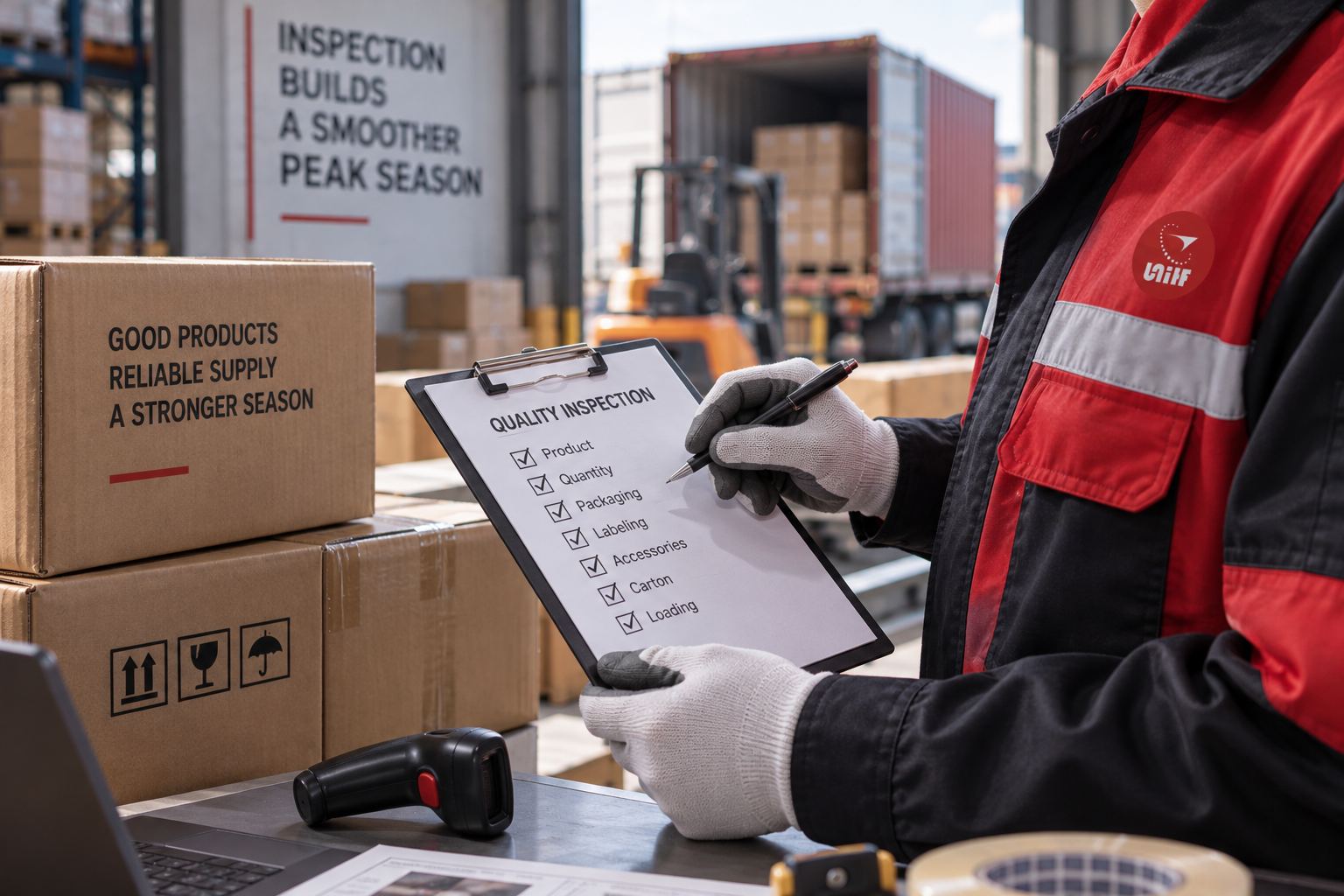
1. Materials or Specifications Change During Production
The approved sample may be correct while mass production uses something different.
Common examples include:
- a substitute raw material;
- a different material grade or thickness;
- another motor, switch, zipper, fastener, connector, or fitting;
- incorrect dimensions or tolerances;
- the wrong color or surface finish;
- a different cable, plug, voltage, or regional configuration;
- an outdated print, label, or packaging version.
These changes can come from purchasing mistakes, material shortages, supplier substitutions, subcontractor changes, or unclear document revisions.
Why finding it early matters
Take a 12,000-unit order.
At 8% production, about 960 units have been made and 11,040 units remain.
If the wrong component is found then, the factory can stop using it, isolate affected stock, replace the component, and continue with corrected production.
If the same problem is found after all 12,000 units are packed, cartons may need to be opened and finished products sorted, repaired, replaced, and packed again.
What should be checked?
Use one current version of each relevant file:
- purchase order;
- product specification;
- approved sample information;
- technical drawing or size chart;
- bill of materials where relevant;
- color or finish reference;
- accessory list;
- label and barcode files;
- packaging artwork;
- buyer inspection checklist.
If a PO and a later drawing contain different measurements, identify the controlling version before inspection.
An Initial Production Inspection can be used at this stage. UTS generally conducts IPI when about 5%–10% of the order has been produced.
The inspector can compare available production units, materials, components, dimensions, workmanship, and available packaging with the approved requirements before most of the order is completed.
Production has already started?
Send the product, order quantity, factory location, current production percentage, and target shipment date. UTS can review whether an early-production inspection is still practical.
Send Production Details2. The Same Defect Starts Repeating During Mass Production
A good first batch does not guarantee the rest.
Operator changes, faster line speeds, new material batches, machine adjustments, worn tooling, or rushed assembly can create defects later.
Typical problems include:
- loose assembly;
- scratches or dents;
- uneven stitching;
- poor printing;
- incorrect alignment;
- unstable construction;
- missing parts;
- dimensions outside tolerance;
- abnormal operation;
- different finishes between batches.
Look at the remaining quantity
Assume an order contains 8,000 units.
At 40% production, about 3,200 units have been produced and 4,800 units remain.
If the same assembly problem appears repeatedly in the inspected units, the factory can correct the process before producing those remaining 4,800 units.
If all 8,000 units are already finished, correction usually means sorting or reworking completed stock.
A During Production Inspection is generally carried out when about 30%–50% of production is complete.
At this stage, check:
- whether the same defect appears across several samples;
- whether dimensions remain within the approved tolerance;
- whether different production batches match;
- whether agreed functions work consistently;
- whether previous corrections were applied;
- whether packaging errors have started to appear.
When a repeated defect is found
Ask the factory to identify:
- Affected quantity: Which units or batches may have the defect?
- Segregation: Where are those units stored?
- Cause: Which material, machine, assembly step, or process caused the problem?
- Correction: What changed before production continued?
- Reworked stock: Which units were repaired or replaced?
If 240 units from one batch may be affected, those 240 units should be traceable. A statement that “everything was checked” does not identify what was actually reworked.
3. The Total Quantity Is Correct but the SKU Mix Is Wrong
Consider an order with:
- 12 models;
- 4 colors;
- 3 sizes.
If every combination applies, that creates up to 144 variations.
Add different barcodes, manuals, accessories, regional versions, or retailer packaging and the number of possible combinations grows again.
A correct total can still hide a shortage
| SKU | Ordered | Available | Difference |
|---|---|---|---|
| Black / Medium | 1,000 | 1,100 | +100 |
| Blue / Medium | 800 | 700 | -100 |
| Total | 1,800 | 1,800 | 0 |
The total is correct at 1,800 units, but Blue / Medium is short by 100.
Other common mix-ups include:
- a Size M product with a Size L label;
- the correct product in another SKU's box;
- a set missing one accessory;
- a U.S. version mixed with an EU version;
- one SKU carrying another SKU's barcode;
- the correct carton count with the wrong assortment inside.
Match each sampled unit across:
product → SKU → color/size/version → accessories → retail box → barcode → master carton
Inspection records should show which SKUs were sampled and how many units came from each selected SKU.
“50 units checked” gives limited information on a large mixed order if the report does not show whether those 50 units came from two SKUs or twenty.
The SKU list, quantities, packaging versions, barcode data, and carton requirements should be ready before final inspection. UTS covers these preparation points in its Final Random Inspection preparation guide.
Inspecting a mixed-SKU seasonal order?
Send the SKU list with quantity, model, color or size, barcode, accessories, and packaging version. UTS can plan the inspection against the actual assortment instead of one combined quantity.
Send Your SKU List4. The Product Is Correct but the Label or Packaging Is Wrong
The product can be fine while the packaging is wrong.
Typical problems include:
- outdated artwork;
- wrong model number;
- wrong language version;
- incorrect manual;
- missing accessories;
- wrong retail barcode;
- barcode assigned to another SKU;
- wrong units per pack;
- incorrect master-carton label;
- missing protective material;
- crushed, torn, wet, or poorly sealed cartons.
Scan barcodes instead of only looking at them
GS1 identifies symbol size, quiet zones, contrast, color choice, damage, packaging interference, and positioning as factors that can affect barcode quality.[1]
When barcode or QR-code checking is included in the agreed UTS inspection scope, check three things:
- Is the code clear and undamaged?
- Can it be scanned?
- Does the scanned result match the approved barcode or SKU data?
If 40 selected codes are checked and one fails, the result is 39/40, or 97.5%. That is not a 100% scan-success result.
Check packaging from the product outward
| Level | What to Check |
|---|---|
| Product | Model, size, color, markings, product label |
| Accessories | Correct item and quantity |
| Retail package | Artwork, barcode, manual, inserts, agreed warnings |
| Inner pack | Assortment, dividers, internal labels, quantity |
| Master carton | SKU, carton quantity, shipping marks, condition |
For example, 500 cartons × 24 units = 12,000 units.
If some cartons contain only 20 units instead of 24, counting closed cartons alone will not identify the unit shortage.
Check both the carton count and the approved units per carton.
Inspection does not replace regulatory compliance work
A product inspection can compare products, labels, markings, and packaging against buyer-approved requirements. It does not prove that those requirements satisfy every law or technical rule in the destination market.
For example, the U.S. Consumer Product Safety Commission states that manufacturers or importers of general-use products subject to applicable CPSC rules must issue the required certification based on a test of each product or a reasonable testing program.[2]
Children's products and other regulated categories can have different testing and certification requirements.
If laboratory testing is required, handle it separately from routine shipment inspection. UTS explains the difference in Product Testing vs. Product Inspection.
Packing has already started?
Send the final artwork, barcode list, SKU file, carton requirement, packed percentage, and shipment date so those items can be included in the agreed inspection scope.
Send Packaging Files5. The Goods Pass Inspection but the Wrong Cartons Are Loaded
A Final Random Inspection checks finished goods before shipment. It does not confirm what enters the container later.
Loading problems include:
- the wrong cartons moved to the loading area;
- one SKU loaded short;
- damaged cartons loaded;
- inspected and uninspected stock mixed;
- the actual carton count not matching the packing list;
- a visibly damaged, dirty, or unsuitable container;
- poor handling or stacking;
- incorrect seal information.
Assume a shipment contains 800 cartons × 20 units = 16,000 units.
If ten cartons are not loaded, the shipment is short by 200 units.
Container Loading Supervision can check container condition, carton identity and count, carton condition, the loading process, and seal information at the loading site.
The IMO/ILO/UNECE Code of Practice for Packing of Cargo Transport Units provides international guidance on packing, securing, and handling cargo transport units.[3]
Use product inspection—not loading supervision—for workmanship, dimensions, function, and other detailed product checks.
Which Inspection Stage Fits the Risk?
| Stage | Typical UTS Timing | Main Use |
|---|---|---|
| Initial Production Inspection | About 5%–10% produced | Materials, components, specifications, dimensions, early workmanship |
| During Production Inspection | About 30%–50% produced | Recurring defects, production consistency, corrective action |
| Final Random Inspection | 100% produced and at least 80% packed | Finished goods, quantity, labeling, packaging, agreed tests |
| Container Loading Supervision | Loading day | Container, cartons, quantity, loading, seal record |
For a 10,000-unit order:
- at 10%, about 9,000 units remain unproduced;
- at 40%, about 6,000 units remain;
- at FRI, production is already complete;
- at loading, major product rework normally requires holding the shipment.
What Does a Final Random Inspection Actually Tell You?
FRI normally uses sampling unless the buyer requests a defined 100% inspection.
ISO 2859-1:2026 defines AQL-indexed acceptance-sampling schemes for lot-by-lot inspection by attributes. The 2026 third edition replaced the previous 1999 edition.[4]
For example, a 4,000-unit lot at General Inspection Level II gives a 200-unit main sample in the UTS sampling table.
Not every check uses all 200 pieces.
The main sample may be used for workmanship, while dimensions, function checks, assembly tests, barcode scans, destructive tests, or carton tests use separately defined sample quantities.
AQL 2.5 does not mean “2.5% defects are allowed”
AQL works with the selected inspection level, lot size, sample size, defect classification, and acceptance/rejection numbers.
An AQL value therefore cannot be converted into a simple statement such as:
“2.5% of this shipment may be defective.”
If every unit must be checked for one characteristic, define that characteristic as a 100% inspection requirement instead of relying on a random sample.
Does Every Peak-Season Order Need IPI, DPI, FRI, and Loading Supervision?
No.
A single FRI may be reasonable when:
- the supplier has a stable quality history;
- the product specification has not changed;
- materials and components are unchanged;
- the order contains few SKUs;
- the packaging has been used before;
- recent orders had no major quality problem.
Consider an earlier check when:
- the supplier is new;
- the product is new;
- a material or key component changed;
- a previous order failed inspection;
- the order contains many SKUs or regional versions;
- packaging is new or retailer-specific;
- production is split across several batches;
- a defect would require several days of rework;
- the shipping date is difficult to move.
Consider loading supervision when carton quantity, mixed SKUs, container condition, or loading accuracy creates a separate shipment risk.
What Should Be Ready Before Inspection?
Provide:
- PO and quantity by SKU;
- final product specification;
- technical drawings or size charts;
- approved sample information;
- dimensions and tolerances;
- agreed functional checks;
- defect classification and AQL settings where applicable;
- final packaging artwork;
- barcode list;
- manuals and inserts;
- accessory list;
- units per carton;
- shipping marks;
- previous inspection findings that need to be checked again.
Remove old versions. If artwork changed from V2 to V3, send V3 and clearly mark V2 as obsolete.
What If the Inspection Finds a Problem?
Confirm:
- what failed;
- which SKUs are affected;
- which production batches may contain the same issue;
- how many units need sorting or rework;
- how corrected goods will be identified;
- what must be checked again before shipment.
Suppose an FRI finds the wrong accessory in several samples from one SKU. Repeating the same random inspection immediately may not solve the problem.
The factory may first need to isolate that SKU, identify the affected quantity, open the relevant cartons, correct the accessory, and repack the goods.
If the issue must be checked on every unit, a 100% Full Inspection after a failed FRI may be more appropriate than another random sample.
The supplier handles production and rework. The inspection company records the agreed checks. The buyer makes the final shipment decision.
Frequently Asked Questions
When should I inspect a peak-season order?
Check materials and specifications around 5%–10% production, production consistency around 30%–50%, finished goods when production is complete and at least 80% packed, and loading risks on loading day.
Is one final inspection enough for a Black Friday order?
It may be enough for an unchanged repeat product from a stable supplier with few SKUs and familiar packaging. Consider earlier checks when the product, supplier, material, component, packaging, or order structure has changed.
How early should FRI be booked?
Work backward from the loading date. Leave enough time for sorting, rework, replacement, and another inspection if needed.
Can FRI prove every unit is defect-free?
No. FRI normally checks samples under an agreed sampling plan. Use a 100% inspection when every unit must be checked for a defined characteristic.
Can product inspection confirm regulatory compliance?
It can compare products, labels, markings, and packaging with approved requirements. It does not replace regulatory review, required certification, or laboratory testing.
The Bottom Line
Use early inspection for materials and specifications, mid-production inspection for recurring defects, FRI for finished goods and packaging, and loading supervision for the cartons that actually enter the container.
Before choosing the inspection stage, confirm four numbers: order quantity, production percentage, packed percentage, and shipment date.
Need to inspect a peak-season order before shipment?
Send UTS the product or SKU list, order quantity, factory location, current production and packing status, and required shipment date. Add the PO, specification, packaging files, or previous inspection report if available.
Send Your Order Details