
Toys & Children’s Products Testing
Our team reviews the target market, product age grading, materials, functions and buyer requirements before arranging an appropriate test scope for toys and children’s products.

The product must be defined before standards and clauses are selected
Toy safety requirements are not chosen from a generic list. The planned use, age group, accessible materials, components, power source and market determine which test items are relevant.
Product and intended use
Confirm whether the item is a toy or another children’s product, how it is used, foreseeable misuse, supplied accessories and special functions.
Age grading and user group
Identify the intended age range, whether mouthing is foreseeable, and whether small parts, cords, projectiles, ride-on use or other age-sensitive risks apply.
Materials and market
List plastics, coatings, textiles, metals, liquids, batteries and colour variants, then confirm each destination market and applicable buyer requirement.
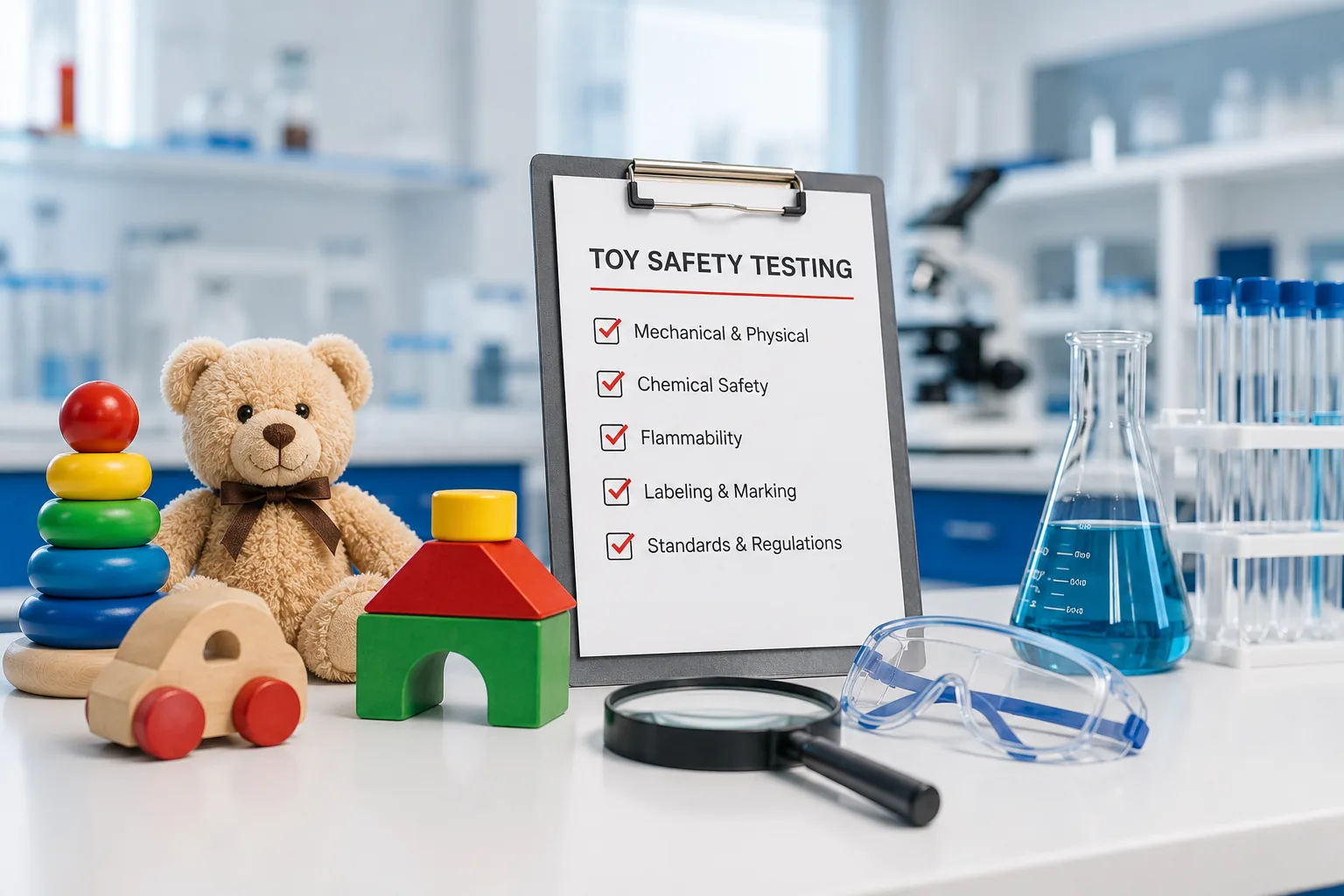
The test programme should match the actual hazards of the product
The final list is confirmed by the selected laboratory after the product information and requested markets are reviewed.
- Physical and mechanical hazards, including small parts, sharp points, sharp edges, cords, hinges and structural failure
- Chemical testing for applicable coatings, substrates, plastics, textiles, liquids or other accessible materials
- Flammability testing where required for the product type and market
- Electrical, thermal or battery-related testing for powered toys and electronic functions
- Warnings, age grading, instructions, tracking information and other required markings
- Product-specific tests for sound, projectiles, ride-on toys, magnets, expanding materials or other special features
Standards and legal requirements must be confirmed for each destination market
The examples below are starting points, not a complete legal determination. The current edition, product scope and additional requirements should be confirmed before testing.
| Market | Reference used for planning | Buyer action before testing |
|---|---|---|
| United States | Children’s toys for ages 14 and under generally require third-party testing to the applicable CPSC rules. ASTM F963-23 has been the mandatory toy-standard version for products manufactured from 20 April 2024.[1] | Confirm product age, applicable ASTM F963 sections, lead, phthalates, small-parts and tracking-label requirements. The manufacturer or importer, not UTS, is responsible for the CPC. |
| European Union | Directive 2009/48/EC remains applicable during the transition. Regulation (EU) 2025/2509 entered into force on 1 January 2026 and applies from 1 August 2030.[2] | Confirm whether the product is a toy, the applicable harmonised standards, chemical requirements, warnings, technical documentation and CE-marking responsibilities. |
| Canada | The Toys Regulations under the Canada Consumer Product Safety Act address mechanical, flammability and other toy hazards.[3] | Confirm product classification, intended age, hazard-specific requirements and any other Canadian consumer-product rules applying to the item. |
| Australia | Mandatory standards are set under AS/NZS ISO 8124. The under-36-month toy standard was updated in 2023.[4] | Confirm the product category, age group, accepted standard option and any separate mandatory rules for lead, magnets, aquatic toys or other features. |
Test requirements can change. Buyers should provide the latest market instruction or ask our project service team to confirm the current laboratory scope before sample submission.
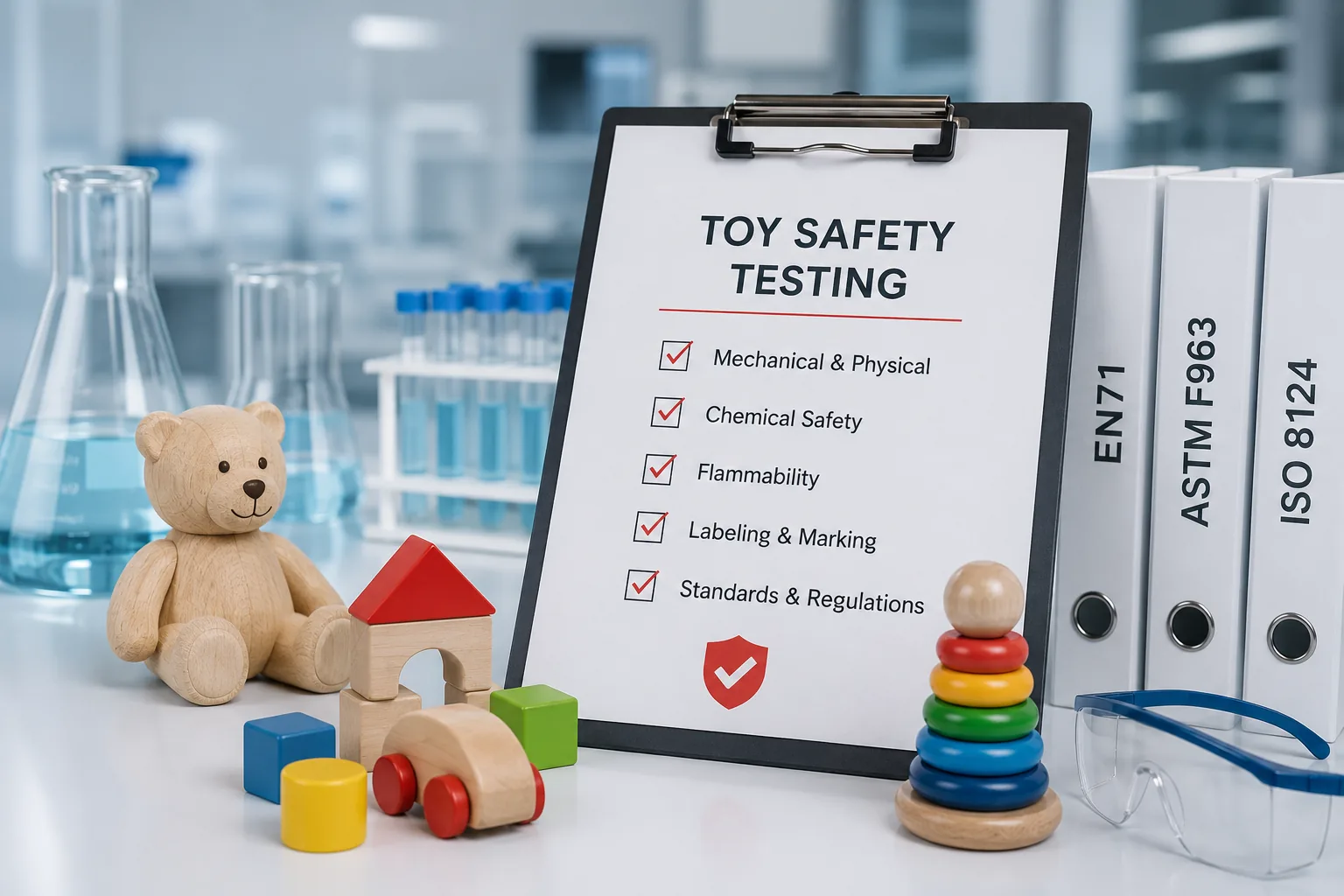
Samples, variants and documents must match the intended production configuration
Testing the wrong colour, coating, battery, accessory or label version can leave important variants outside the report scope.
- Provide representative finished samples and the quantity confirmed by the laboratory
- Identify every material, coating, colour and component variant that may affect the test plan
- Provide the BOM, technical drawings, user instructions, warnings and packaging artwork when available
- State the target age and destination markets in writing
- Record model numbers, sample condition and any pre-test preparation
- When barcode verification is included in the visual scope, checked samples should achieve 100% readability; unreadable codes should be recorded, corrected and rechecked
Our project service team coordinates the request from scope review to report delivery
Testing is arranged only after the product information, destination market and required laboratory clauses are sufficiently clear.
Requirement review
Confirm the product, age grading, materials, models, markets and buyer instructions.
Test plan and quotation
Confirm the selected standards, clauses, sample quantity, lead time and destructive tests.
Sample registration
Record the submitted models, variants, condition and documents before testing begins.
Laboratory testing
The selected laboratory performs the approved physical, chemical or other test items.
Report review
Our team provides the report for client review and follows up on questions or retesting needs.
A failed result should be traced to the affected sample, requirement and material or design feature
Replacing a component without checking the exact failure cause can create repeated failures or leave related variants unresolved.
Read the failed clause
Identify the tested requirement, measured result, sample condition and any preconditioning or use-and-abuse sequence.
Trace the affected configuration
Determine which model, colour, coating, plastic, accessory, battery or construction detail is represented by the failed sample.
Confirm the retest scope
Ask the laboratory whether targeted retesting is sufficient or whether design changes require a new full test programme.
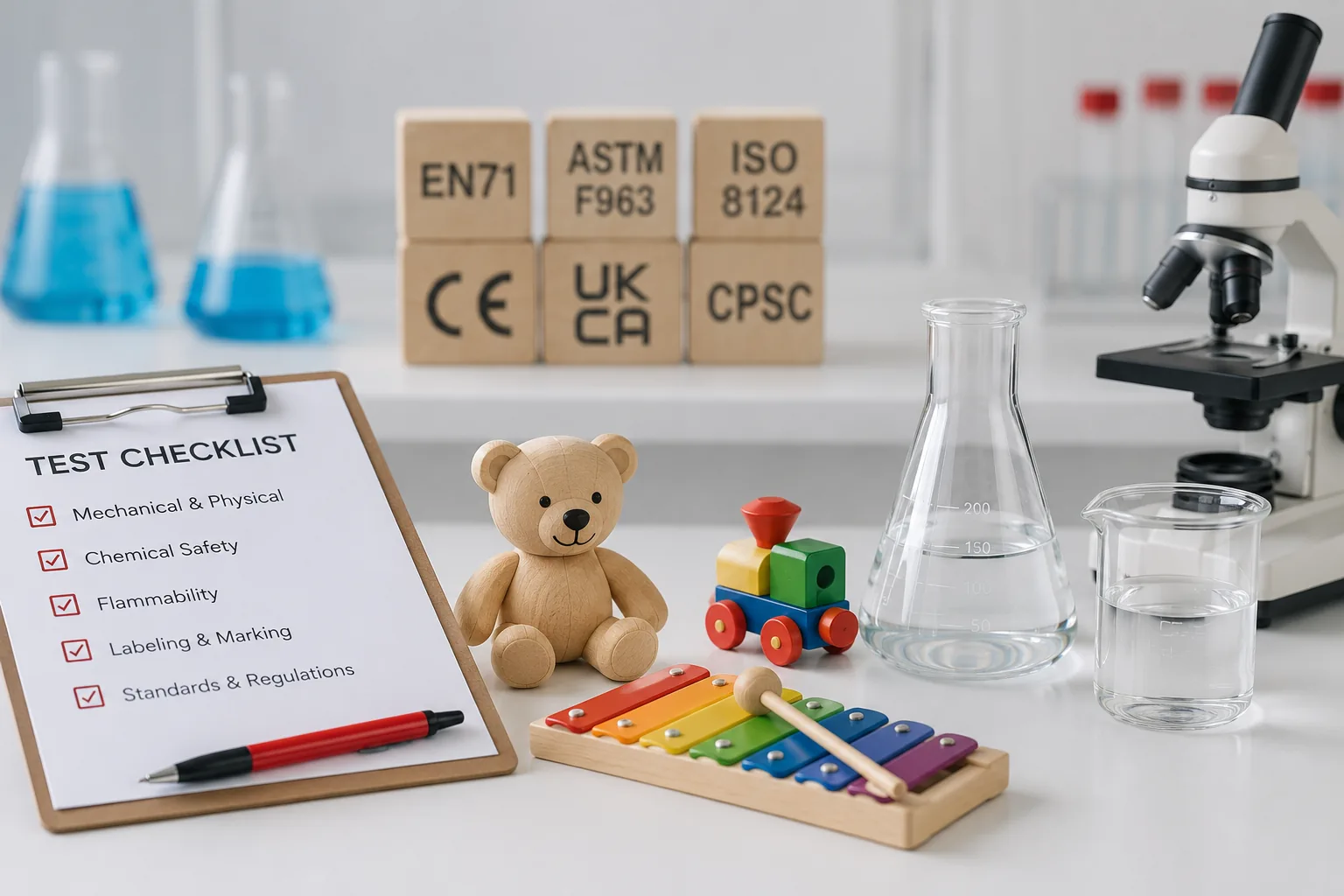
A test report is evidence for the tested samples and approved scope, not a universal product guarantee
The responsible manufacturer, importer or market operator remains accountable for product classification, technical documentation, declarations, certificates and continued production conformity.
What the report can support
It can show the laboratory methods, tested samples, applicable clauses, results and observations included in the approved programme.
It can also help buyers identify failed requirements, request corrective action and decide whether additional tests are needed.
What the report does not do
It does not automatically cover untested variants, future production changes, every destination market or every law that may apply.
UTS does not issue a Children’s Product Certificate, CE marking, notified-body approval or legal opinion through this service.
Laboratory testing and product inspection answer different questions
Testing evaluates selected samples against specified methods. Inspection checks actual production goods, quantities, workmanship, function, labels and packaging at a defined production stage.
Sample Evaluation
Review an approved or development sample before bulk production and record specification or workmanship gaps.
View Sample Evaluation →Final Random Inspection
Check completed production using the approved checklist, AQL sampling and packaging requirements before shipment.
View Final Random Inspection →Children’s Product Safety Guide
Review common inspection and testing risks such as small parts, sharp edges and material hazards.
Read the buyer guide →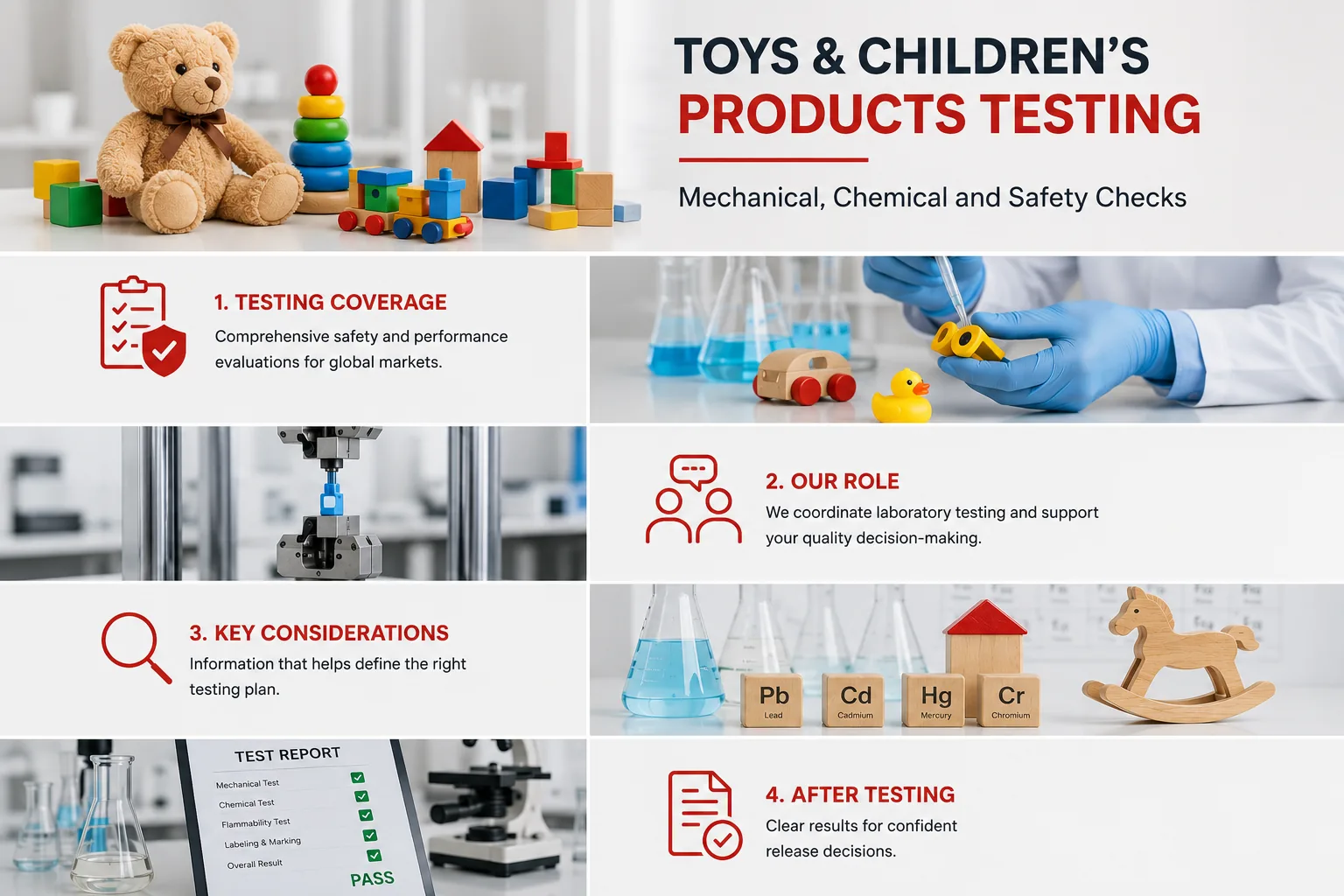
Toys and children’s products testing questions
These answers clarify sample requirements, market coverage, failure handling and the boundary of the service.
Does UTS issue a Children’s Product Certificate, CE marking or product certification?
No. UTS provides testing coordination and test-report support within the approved scope. The manufacturer, importer or other responsible economic operator remains responsible for the applicable declaration, certificate or market-placement obligation.
How many samples are required for toy testing?
The quantity depends on the product type, age grade, materials, colour variants, requested clauses and whether destructive tests are required. Our project service team confirms the laboratory sample requirement before the samples are sent.
Can one test report cover every country and every product variant?
Usually not. Market rules, standard editions, product functions, materials and age grades differ. Untested colours, components or variants should not be assumed to be covered unless the selected laboratory confirms that they are represented by the approved test plan.
When should buyers arrange testing?
Testing is commonly arranged before mass production for design and material risk, and again when final materials, components, labels or functions change. The suitable timing depends on product risk and the buyer’s release plan.
What happens when a sample fails a test?
The report should identify the failed requirement and tested sample. The buyer and supplier can review the affected material, component or design, arrange corrective action, and confirm whether a targeted retest or a new full test is required.
Send the product, target age and destination markets
Include product photos, model numbers, materials, labels, available BOM information, existing reports and the intended testing date.