
CE, RoHS and REACH Testing Services
We coordinate product-specific laboratory testing and document review that may support CE conformity work, RoHS substance restrictions and REACH obligations. These are different compliance routes, so the scope must start with the product, materials, intended use and target market.

Three different compliance questions
Combining CE, RoHS and REACH into one generic “certificate” request produces weak evidence. Our office team first separates the legal route, product scope and evidence needed.
Which EU product rules apply?
CE marking is required only for products covered by EU legislation that provides for the mark. Product safety, EMC, radio, machinery or other requirements may be involved depending on the product.
European Commission reference →Which RoHS materials are at risk?
The review maps electrical parts, solders, cables, plastics, coatings and other homogeneous materials against the restricted-substance list and any relevant exemption.
European Commission RoHS page →Which REACH duties may apply?
The product, material, substance, concentration, supply-chain role and intended use determine whether Annex XVII, Candidate List or other REACH requirements need review.
ECHA REACH overview →
Build the test plan from the product structure
A single finished product may contain many materials supplied by different factories. Our project service team reviews the bill of materials, component list, colours, coatings, suppliers and previous reports before laboratory work is arranged.
- Product name, model family and intended use
- Target EU market and applicable customer requirements
- Electrical functions, radio functions and power specifications
- Bill of materials and homogeneous-material breakdown
- Plastic resins, cables, solders, coatings, inks and adhesives
- Supplier declarations, previous reports and change history
Components that often change the scope
Risk does not come only from the main housing or printed circuit board. Small parts and supplier changes can affect the evidence needed.
Printed circuit assemblies
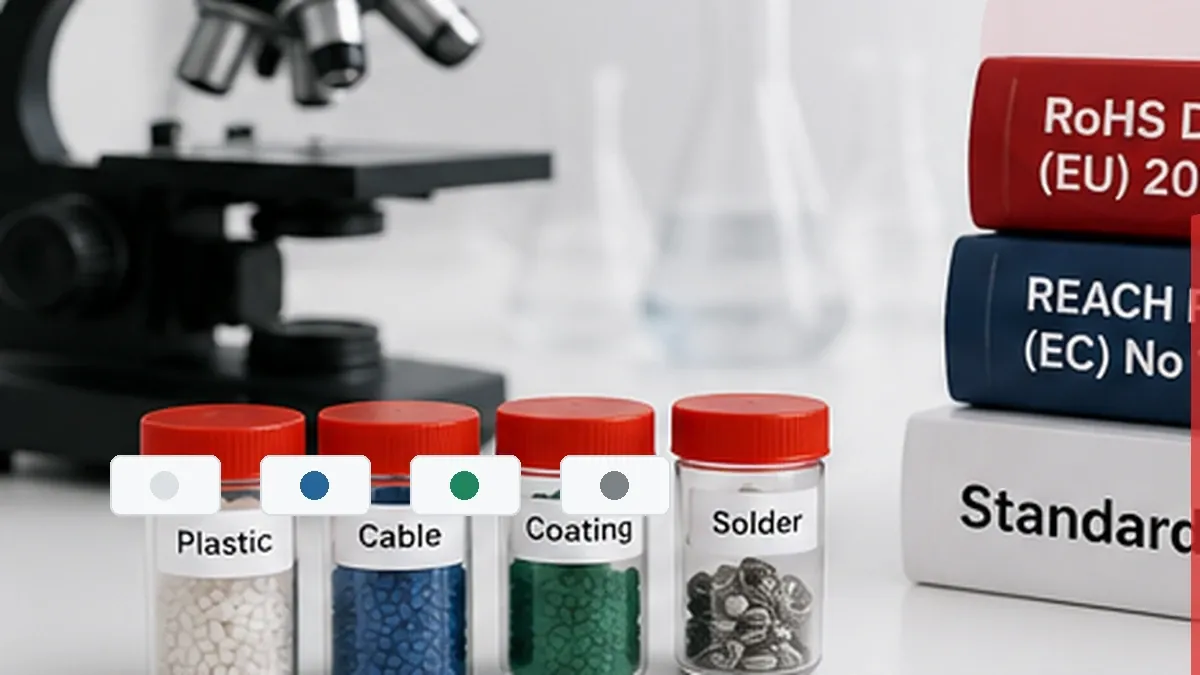
Solder, component terminations, connectors, coatings and board materials may require separate consideration.
Cables and power parts
Wire insulation, plugs, adapters, power supplies and strain-relief materials can contain different formulations.
Plastic housings
Resin type, colour masterbatch, flame retardants, recycled content and supplier changes can affect grouping.
Metal parts and finishes
Plating, passivation, paint, alloys and surface treatments should be identified rather than treated as one metal.
Coatings, inks and adhesives
Printed labels, decorative coatings, glues and encapsulants may require targeted screening based on use and composition.
Packaging and accessories
REACH restrictions or customer requirements may extend beyond the powered product to accessories and packaging materials.
RoHS evidence is assessed at homogeneous-material level
Directive 2011/65/EU, as amended, lists ten restricted substances. The maximum concentration is generally 0.1% by weight in homogeneous materials, while cadmium is 0.01%. Product-specific exemptions and their validity must be checked separately.
- Lead, mercury, hexavalent chromium, PBB and PBDE: 0.1%
- Cadmium: 0.01%
- DEHP, BBP, DBP and DIBP: 0.1%
- Exemptions are application-specific and time-limited
- A finished-product average is not a substitute for material-level evidence
Restricted substances and maximum concentration values
These values are taken from Annex II of the RoHS framework. The selected laboratory still needs the material map and product category before confirming the method and sample quantity.
| Restricted substance | Maximum concentration by weight in homogeneous material | Typical evidence question |
|---|---|---|
| Lead (Pb) | 0.1% | Solder, alloys, pigments, glass, ceramics or exemption-relevant applications |
| Mercury (Hg) | 0.1% | Lamps, switches, displays, measuring devices or specialised components |
| Cadmium (Cd) | 0.01% | Pigments, plating, stabilisers, contacts and battery-related parts |
| Hexavalent chromium (Cr VI) | 0.1% | Passivation, anti-corrosion finishes and treated metal surfaces |
| PBB / PBDE | 0.1% each | Flame-retarded plastics, housings, connectors and cable materials |
| DEHP / BBP / DBP / DIBP | 0.1% each | Flexible plastics, cable insulation, coatings, inks and soft components |

REACH cannot be reduced to one fixed SVHC test list
The Candidate List changes over time. Annex XVII restrictions can apply to specific substances, materials, products or uses. For articles containing a Candidate List substance above 0.1% weight by weight, EU and EEA suppliers may have communication duties and, depending on the conditions, notification or SCIP obligations.
- Check the current Candidate List at the time of assessment
- Review Annex XVII entries relevant to the product and intended use
- Assess each article and component with traceable material information
- Do not treat “below 0.1% SVHC” as proof of complete REACH compliance
- Record supplier evidence and changes that may affect the conclusion
Laboratory reports support the technical file, but do not replace it
CE marking applies only where relevant EU legislation requires it. The manufacturer remains responsible for identifying the legislation, choosing the conformity route, preparing technical documentation, issuing the EU Declaration of Conformity and affixing the mark.
Applicable legislation
Depending on the product, the scope may involve electrical safety, EMC, radio equipment, machinery, toys or other EU rules. Not every product requires CE marking.
Manufacturer responsibilities →Technical documentation
Useful evidence may include design information, risk assessment, specifications, component records, test reports, instructions, labels and production-control information.
EU CE guidance →EU Declaration of Conformity
The declaration is drawn up and signed by the manufacturer or authorised representative as required. UTS does not sign this declaration for the product owner.
Marking and label consistency
When included in the inspection scope, our team can compare the product model, rating label, CE mark, packaging and buyer-provided documents for visible consistency before shipment.
From product information to report review
The testing scope is confirmed before samples are dispatched. This reduces unnecessary tests and makes the report easier to connect to the actual product.
Information review
Confirm product, market, models, materials, legislation and buyer requirements.
Risk mapping
Identify components, homogeneous materials and substance-specific risks.
Sample plan
Confirm sample grouping, quantities, preparation and selected laboratory methods.
Laboratory work
Tests are performed against the confirmed methods and identified samples.
Report review
Our office team provides the report and follows up on scope, results and next actions.
Review the tested sample, method and legal reference together
A pass statement without a clear sample description and scope is weak evidence. Buyers should confirm exactly what the report covers.
Report review points
- Product name, model, sample photos and received condition
- Component or homogeneous-material identification
- Test methods, legal references and stated limits
- Results, reporting limits, exemptions and stated conclusions
- Whether variants, colours and suppliers are actually covered
Service boundary
UTS does not issue CE certification, an EU market approval, a manufacturer’s EU Declaration of Conformity or legal advice.
Responsibility for product classification, applicable legislation, market placement, declarations, technical documentation and ongoing production conformity remains with the responsible economic operator.
CE, RoHS and REACH testing questions
These answers clarify certification boundaries, material coverage, Candidate List logic and the information needed before testing.
Does UTS issue CE certification or an EU market approval?
No. CE marking is a manufacturer responsibility linked to the applicable EU legislation, conformity assessment, technical documentation and EU Declaration of Conformity. Our team can coordinate product-specific laboratory testing and check whether labels, models and documents are consistent with the agreed scope, but we do not issue CE certification or government approval.
Is RoHS testing the same as REACH testing?
No. RoHS focuses on restricted substances in electrical and electronic equipment and applies limits at homogeneous-material level. REACH is a broader chemicals regulation that may involve Annex XVII restrictions, Candidate List communication duties, authorisation requirements and other obligations depending on the product, substance and supply-chain role.
Can one test report cover every component and model?
Usually not. Coverage depends on the bill of materials, homogeneous materials, colours, coatings, suppliers, component changes and the selected methods. Our project service team reviews grouping logic and asks the selected laboratory to confirm the sample plan before testing.
Does a REACH Candidate List result below 0.1% remove every REACH obligation?
No. The 0.1% weight-by-weight threshold is important for Candidate List communication and certain notification duties for articles, but other REACH restrictions or substance-specific requirements may still apply. The current Candidate List and Annex XVII entries should be checked for the product and intended market.
What should a buyer prepare before testing?
Provide the product description, target market, model list, bill of materials, component and material suppliers, colours and coatings, electrical specifications, intended use, available declarations, previous reports, technical documents and any applicable customer requirements. Missing composition data may require a broader or more conservative test plan.
Send the product structure before requesting a test list
Include the model list, target market, bill of materials, component suppliers, colours, coatings, electrical functions, previous reports and buyer requirements.