For most Black Friday orders, schedule the final inspection several days before the latest acceptable loading date—not the day before shipment.
For a simple repeat order, a 3–7 day buffer between Final Random Inspection (FRI) and loading is a practical planning target. It is not an inspection standard. Allow more time if rework may involve replacement parts, printing, repacking or large-scale sorting.
For higher-risk orders, inspect earlier: IPI at about 5%–10% production, DPI at about 30%–50%, and FRI when production is 100% complete and at least 80% packed.
Work backward from the date the inventory must be ready for sale.
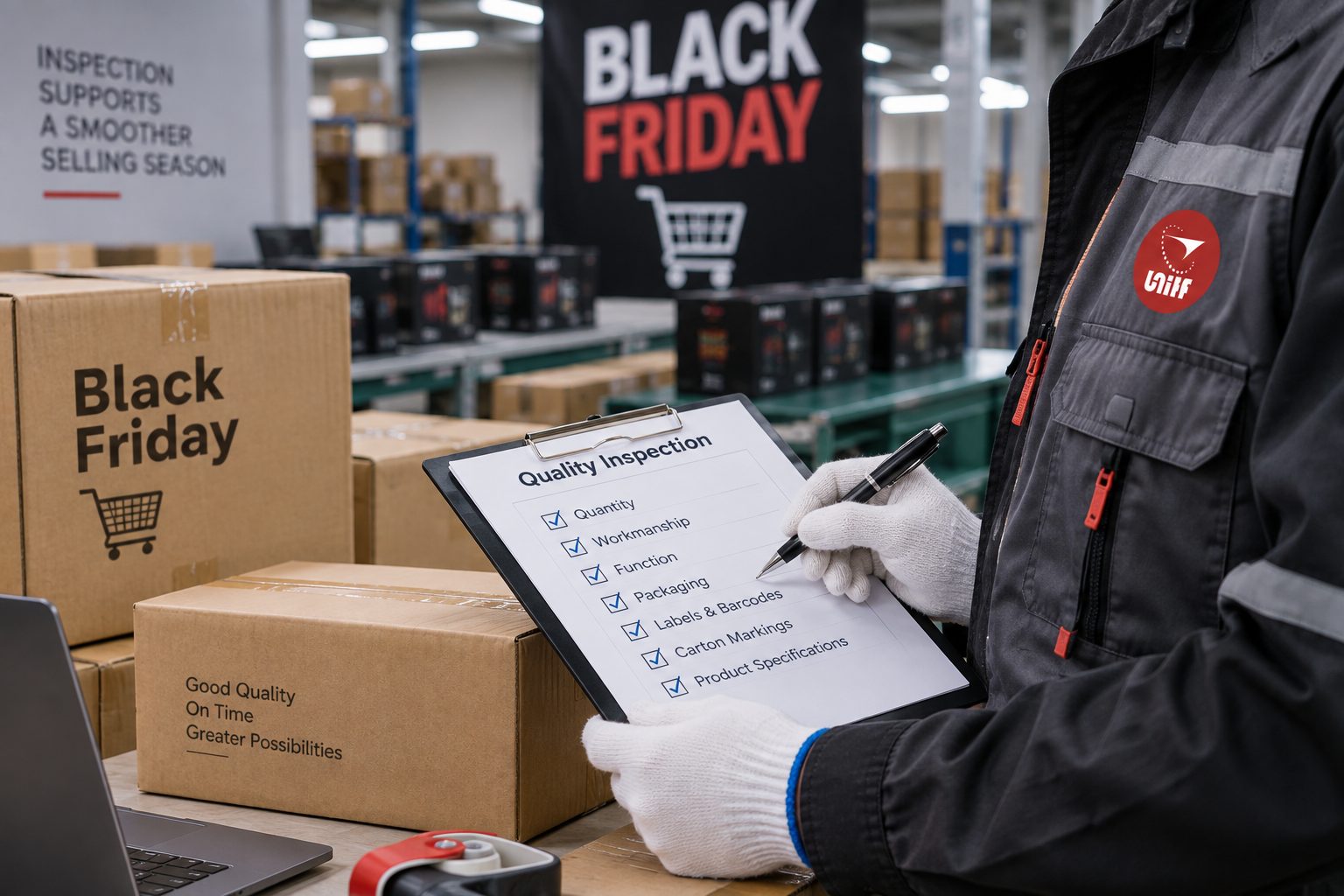
3Black Friday Inspection Timing at a Glance
| Production Stage | Inspection | What It Checks | Useful For |
|---|---|---|---|
| 5%–10% produced | Initial Production Inspection (IPI) | First units, materials, components and specifications | New supplier, new product, specification changes |
| 30%–50% produced | During Production Inspection (DPI) | Mass-production consistency and earlier corrections | Long runs, repeated defects, multi-SKU orders |
| 100% produced, at least 80% packed | Final Random Inspection (FRI) | Finished goods, quantity, function, labels and packaging | Final shipment review |
| Loading day | Container Loading Supervision | Container, cartons, quantity, loading and seal details | Mixed-SKU, consolidated or high-value shipments |
Already producing your Black Friday order?
Send the production percentage, order quantity, SKU list, factory location and planned loading date. These details help determine whether the order is at IPI, DPI or FRI stage.
Request an InspectionStart With the Inventory-Ready Date
Your real deadline is when sellable stock must reach the warehouse, fulfillment center or retail network.
Work backward in this order:
Inventory-ready date → destination receiving → customs and inland transport → arrival → international transport → loading → FRI → possible rework and reinspection → production.
Suppose your inventory must be ready on November 5. Your logistics plan allows 7 days for destination clearance and receiving and 25 days for international transport.
In that example, the goods need to arrive around October 29 and leave the origin around early October. The inspection schedule must therefore be built around that early-October departure, not around Black Friday at the end of November.
Transit time varies by route and shipping method. Use your actual freight schedule when calculating the dates.
How Much Time Should You Leave Between FRI and Loading?
A day-before-loading FRI leaves almost no time for sorting, rework or reinspection.
| Late Inspection | Date |
|---|---|
| FRI | October 19 |
| Container loading | October 20 |
| Shipping cutoff | October 21 |
If the October 19 inspection finds wrong labels, repeated function failures or packing errors, the factory has about one day before loading.
Move the inspection earlier:
| Inspection With Recovery Time | Date |
|---|---|
| FRI | October 14 |
| Sorting or rework | October 15–17 |
| Possible reinspection | October 18 |
| Container loading | October 20 |
This leaves several days for correction before loading.
For a simple repeat order, start with a 3–7 day planning buffer. Add more time for large quantities, complicated repairs, replacement parts or packaging changes.
Use IPI at 5%–10% for Problems That Need to Be Caught Early
Initial Production Inspection checks early production against the approved requirements.
Use IPI when you have:
- a new supplier;
- a new product;
- a new material or component;
- changed dimensions or construction;
- new labels or artwork;
- a large seasonal order where one mistake could spread through the full batch.
Take a 10,000-unit order.
At 10% completion, about 1,000 units have been produced and about 9,000 remain.
If the first 1,000 units use the wrong component, the factory can correct the setup before making the remaining 9,000. If the same issue is found after all 10,000 units are complete, the finished goods may need sorting, rework or replacement.
Use DPI at 30%–50% to Check Mass Production
A correct first batch does not guarantee later batches.
During Production Inspection is normally arranged at about 30%–50% production. Enough units exist to check repeated defects while much of the order is still unmade.
Use DPI when:
- production runs for several weeks;
- IPI found a problem that the factory says it corrected;
- several production batches or lines are involved;
- the order contains many SKUs;
- the supplier has a history of repeated defects;
- waiting until FRI would leave too little time for correction.
For a 20,000-unit order at 40% completion, about 8,000 units have been produced and 12,000 remain.
If DPI finds the same assembly problem on several samples, the supplier can sort or rework the finished quantity and correct the process for the remaining 12,000 units.
At 100% completion, only finished goods remain. Correction means sorting, reworking or replacing them.
DPI does not replace FRI. The remaining production still needs to be completed.
Check Multi-SKU Readiness by SKU
For multi-SKU orders, check production readiness by SKU, not only by total quantity.
One model may already be packed while another has not entered production. If a SKU is unavailable, it cannot be covered by the final inspection.
Orders with many models, colors or sizes also need planned sample allocation. UTS explains SKU-level sampling, quantity reconciliation and packaging checks in its multi-SKU inspection guide.
Book FRI Only When the Order Is Ready
UTS normally arranges Final Random Inspection when:
- 100% of the ordered goods are produced;
- at least 80% are packed;
- the required SKUs are available at the inspection location;
- finished cartons can be opened for random sampling.
Unfinished SKUs cannot be included in the final sample.
The 80% packing point also allows the inspector to check final packaging, labels, barcodes, assortment and carton information on packed goods.
Before FRI, send the final versions of:
- purchase order and SKU quantities;
- product specifications;
- approved sample information;
- drawings and tolerances;
- AQL and defect criteria;
- functional check instructions;
- labels and barcode data;
- packaging artwork;
- carton markings;
- previous defect or recheck requirements.
The UTS FRI preparation guide explains how these files should be matched to the final order.
Your supplier says the order is ready?
Confirm four figures before booking FRI: ordered quantity, finished quantity, packed quantity and quantity by SKU.
Submit the Order DetailsDo Not Turn AQL Into a Fixed Percentage
FRI normally uses random sampling rather than checking every unit.
ISO 2859-1:2026 defines AQL-indexed sampling schemes for lot-by-lot inspection by attributes.[1]
AQL sample size is not a fixed percentage such as “inspect 5% of the order.” It depends on the lot size, inspection level and selected sampling plan.
NIST describes acceptance sampling as selecting a random sample from a lot and using the results to support an accept-or-reject decision. Its purpose is not to estimate the exact quality level of every unit in the lot.[2]
For example, the current UTS FRI preparation guide shows a 4,000-unit lot at General Inspection Level II with a 200-unit main sample. Other lot sizes and inspection levels can produce different sample sizes.
A passing sample does not mean every unit is defect-free.
Small Percentages Can Still Mean Hundreds of Units
For a 10,000-unit order, a problem affecting 2% of the quantity equals:
10,000 × 2% = 200 units.
Relabeling 200 units may be manageable.
Opening, repairing, function-testing and repacking 200 units takes longer.
The same 2% problem is easier to correct six days before loading than one day before loading.
Use the defect type, affected quantity and rework method when setting the inspection buffer.
When Is FRI Alone Enough?
A stable repeat order may only need FRI.
FRI alone may be suitable when:
- the same supplier has delivered consistent previous orders;
- the product is unchanged;
- materials and construction are unchanged;
- artwork and packaging are unchanged;
- there is enough time after FRI for correction if needed.
Add an earlier inspection when the order introduces new production risk.
| Order Situation | Possible Inspection Plan |
|---|---|
| Stable repeat product | FRI |
| New supplier, established product | IPI + FRI |
| New supplier and new product | IPI + DPI + FRI if the risk justifies all three stages |
| Long production run | DPI + FRI |
| Large multi-SKU order | DPI + FRI |
| Previous repeated defect | Targeted DPI + FRI |
These are planning examples, not fixed rules.
What Should You Do If FRI Fails?
A failed FRI does not automatically mean ship or cancel.
Check five things:
- What failed? Workmanship, dimensions, function, quantity, label, barcode or packaging?
- Which SKUs are affected?
- Is the defect isolated or repeated?
- What will the factory sort, rework or replace?
- Is there enough time to verify the correction?
Ask the supplier for a dated rework plan.
Suppose FRI is six days before loading. The factory uses two days for sorting, one day for relabeling and one day for repacking. A reinspection can still fit before loading.
If FRI is the afternoon before loading, that sequence no longer fits.
Use a targeted reinspection when the corrected scope is clearly defined. If the problem may affect a wider part of the lot, a broader recheck may be needed.
The UTS guide to 100% inspection after a failed FRI explains how defect scope, correction and recheck criteria can be separated.
FRI failed and loading is close?
Send the inspection report, affected SKU, factory rework status and latest acceptable loading date. The follow-up inspection should check the failed points and corrected quantity.
Arrange a ReinspectionUse Loading Supervision for the Loading Stage
A passed FRI does not confirm what is actually loaded.
Container Loading Supervision takes place during loading and can check:
- visible container condition;
- carton condition;
- carton count;
- shipping marks;
- SKU identification;
- loading process;
- loaded quantity;
- container and seal details.
Use it for consolidated orders, mixed SKUs, critical carton counts or shipments where loading records matter.
ISO 17712 sets requirements for mechanical freight-container seals used in international commerce.[3]
Loading supervision does not replace FRI. Loading day is too late for major product rework.
Product Inspection Does Not Replace Laboratory Testing
On-site inspection can check agreed workmanship, dimensions, function, quantity, labels and packaging.
It does not replace laboratory testing or certification where those are required. UTS explains the difference in its guide to product testing versus product inspection.
For U.S.-bound imports, U.S. Customs and Border Protection states that importers are expected to exercise reasonable care in their importing operations.[4]
A third-party product inspection does not transfer that responsibility to the inspection company.
A Simple Black Friday QC Calendar
| Step | Planning Point |
|---|---|
| 1 | Set the date inventory must be ready for sale. |
| 2 | Subtract destination clearance, receiving and inland transport time. |
| 3 | Subtract international transport time. |
| 4 | Set the latest acceptable loading date. |
| 5 | Place FRI several days before loading so correction is still possible. |
| 6 | Add DPI at 30%–50% if mass-production risk needs an earlier check. |
| 7 | Add IPI at 5%–10% for new suppliers, products or specifications. |
Before booking FRI, ask one question: if the inspection fails, is there still time to fix and reinspect the order?
If the answer is no, move the inspection earlier.
Frequently Asked Questions
How many days before loading should I inspect a Black Friday order?
For a simple repeat order, a 3–7 day buffer is a practical planning target. Add more time for large quantities, complex repairs, replacement parts or packaging changes.
Can FRI be done two weeks before loading?
Yes, if production is 100% complete and at least 80% packed. FRI depends on production readiness, not how close the loading date is.
Is FRI enough for a Black Friday order?
It may be enough for a stable repeat order. Add IPI or DPI when the supplier, product, material, specification or production process introduces additional risk.
When should I use IPI?
Use IPI around 5%–10% production when you need to check new materials, components, construction, specifications or early workmanship before most of the order is made.
When should I use DPI?
Use DPI around 30%–50% production when you need to check mass-production consistency, repeated defects or corrections from an earlier inspection.
Can I book FRI if only 70% is packed?
UTS normally schedules FRI when production is 100% complete and at least 80% is packed. At 70%, wait for more packing if final labels, assortment and carton checks are part of the required scope.
Does a passing FRI mean every unit passed inspection?
No. FRI normally uses random sampling. A passing sample does not mean every unit was individually inspected.
Should I reinspect after the factory repairs a failed order?
Reinspection is useful when the original defect was significant, repeated or affected a clearly defined quantity. The recheck should focus on the failed points and corrected goods.
Do I still need loading supervision after FRI?
Use it when you need independent checks of the container, carton count, loading process, loaded quantity or seal information. It covers the loading stage, not the finished-product inspection stage.
Finally
Leave enough time to fix a failed inspection.
For a simple order, plan FRI several days before loading. Add DPI at 30%–50% when defects could spread through mass production, and IPI at 5%–10% for new suppliers, products or specifications.
Set the inventory-ready date first, then work backward.
Not sure which inspection stage your order has reached?
Send the current production percentage, packed percentage, SKU quantity, factory location and planned loading date. UTS can match the inspection stage to the actual order status.
Start an Inspection Request