Short answer: Yes. A third-party production capacity audit can check whether factory records and on-site observations support the supplier’s claimed output. It can document a shortfall or show that the evidence is incomplete. Neither finding alone proves the supplier inflated the number, and one visit cannot guarantee how much the factory will make for your order.
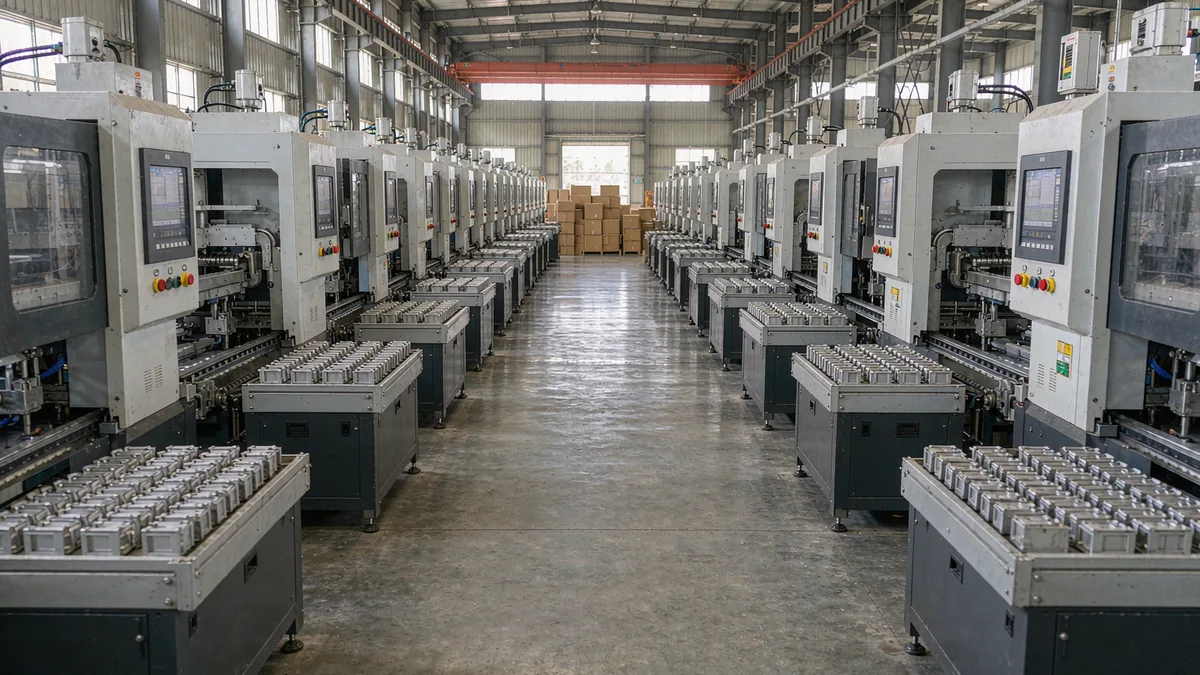
Capacity is checked against machine count, shift pattern and recorded output, not the claim alone.
Why the quoted rate may not match what the factory can deliver
A factory can show that a line has produced at the quoted rate without showing that the same line is available for your order. Separate what the line has demonstrated under comparable conditions from how much of that line time remains during your production window. Existing orders, peak-season demand, material shortages, or work assigned to an unverified subcontractor can change the answer.
How UTS checks a capacity claim on site
At UTS, we use a checklist agreed with you before the production capacity audit. Our team compares the factory’s claimed rate with daily output records and the conditions we can see on the floor. A running machine tells us it was operating during the visit. Output records, running hours, and downtime give that observation context. Where the factory shares utility records, we use them as an additional cross-check, not as a substitute for production records.
- Lines and equipment: Which lines and machines handle the work, how work moves between stations, and which equipment is running.
- Workers and shifts: Staffing visible during the visit and the shift pattern shown in available records.
- Materials and work in process: What is on hand or already on the line, compared with the production schedule.
- Warehouse and storage: Available storage space and handling conditions for incoming materials, work in process, and finished goods.
- Existing orders and outsourced work: Jobs already using the same lines and any evidence that a production step takes place elsewhere.
We document what we can verify within the agreed scope. If an area is closed or a record is missing, we record the gap rather than treating the supplier’s statement as verified.
Which records make a capacity claim easier to verify?
- Dated output by product and line: Match the unit being counted as well as the time period. A log of parts coming off a machine does not substantiate a claim for finished units if those parts still need assembly or packing. A factory-wide total also does not show what the line assigned to your order produced.
- Shift and equipment records: If the supplier says a second shift accounts for the extra capacity, compare that claim with dated output and equipment running hours for that shift, where available. A shift on the schedule shows what is planned; it is not proof that the shift has run at the claimed rate.
- The schedule for your order window: Look for existing jobs on the same line and dates, not just an overall monthly total. If the supplier plans to send finishing elsewhere, clarify which site would do that work. Do not count its output as verified capacity from a visit to the main factory alone.
What a gap between claimed and recorded output means
Compare the same product, site, and time period. In this hypothetical example, a supplier claims 10,000 finished units per week for one line. Records for a comparable five-day week show 1,200 finished units per day. These figures are illustrative, not results from a UTS audit.
| Measure | Finished units |
|---|---|
| Supplier’s claim | 10,000 units per week |
| Output shown in the records | 1,200 units per day × 5 days = 6,000 units per week |
| Gap against the claim | 4,000 units, or 40% of the claim |
The records in this example do not substantiate the 10,000-unit claim. They do not establish that 6,000 is the line’s permanent maximum or that all 6,000 units would be available for your order. A claimed second shift or additional line would need evidence of its own.
How an existing order changes the estimate
Continue the same hypothetical example. Suppose you need 5,000 units that week, but another order takes two of the five comparable production days. At 1,200 finished units per day, the remaining three days give a planning estimate of 3,600 units, assuming staffing and materials are in place. That is 1,400 units short of your order. The 4,000-unit gap in the table tests the supplier’s claim against historical records; the 1,400-unit gap tests your order against the time assumed to be available. Neither calculation is a delivery forecast.
What to prepare before the audit
- The supplier’s name, factory address, product, order quantity, and required production dates.
- The capacity claim in writing, including the units per day or week, working days, shifts, and lines included in the figure.
- The machine list, line layout, recent daily output records for the relevant product and line, and the production schedule covering your dates, if available.
- Any specific claim you want us to check, such as an added shift or whether finishing is done in-house.
What the UTS capacity audit report includes
We deliver the report within 24 hours of the site visit. It separates three kinds of information:
- What we saw: Conditions observed on site and what the reviewed records showed, with photographs where the factory permits them.
- What the factory claimed: The supplier’s statements, kept distinct from the evidence we could verify.
- What could not be checked: Missing records, inaccessible areas, and other limits on what we could verify.
Our report presents findings only. It does not include corrective action plans, improvement recommendations, or advice on whether to approve a supplier or release a shipment.
How to use the findings in your own planning
These are general buyer options, not recommendations in the UTS report. Match the evidence to the assumption that matters for your order:
- The records support the rate: Check whether the schedule and materials cover your production window. Historical output alone does not show that those days are available to you.
- Comparable records show less output: Ask what accounts for the difference. If the supplier relies on an additional line, ask for records for that line rather than adding its claimed output to the estimate.
- A key condition could not be checked: Leave it out of the evidence-backed estimate. You can model it separately as an assumption, but a missing record does not prove the supplier’s statement false.
If your concern is product quality rather than available capacity, a during-production inspection or a final inspection of finished goods answers a different question. Inspection findings can inform your decision; UTS does not authorize shipment release.
Questions about verifying factory capacity
What if the factory has never made my product?
Records for a similar product can show what the line has done, but they do not establish your product’s rate. A different assembly or packing step can make the comparison misleading. For your own planning, treat the similar-product rate as provisional and keep it separate from any output recorded for your product.
Can an audit confirm a delivery date?
No. A visit documents the conditions and records available at the time. Material arrivals, staffing, downtime, and competing orders can change after the audit.
When do I need a factory evaluation or a quality management system audit instead?
A factory evaluation is a better fit if your main question is whether the supplier operates at the site it declared. If you need to assess how the supplier manages its processes, consider a quality management system audit against agreed criteria. ISO 19011 provides guidance on auditing management systems [1]. The agreed criteria may include ISO 9001, which sets requirements for a quality management system [2]. A UTS capacity audit does not certify the factory, and our buyer-focused quality management system audit does not issue an ISO certificate.
Send our team the supplier’s location, the claimed production rate, and your order dates so we can discuss what to verify on site.